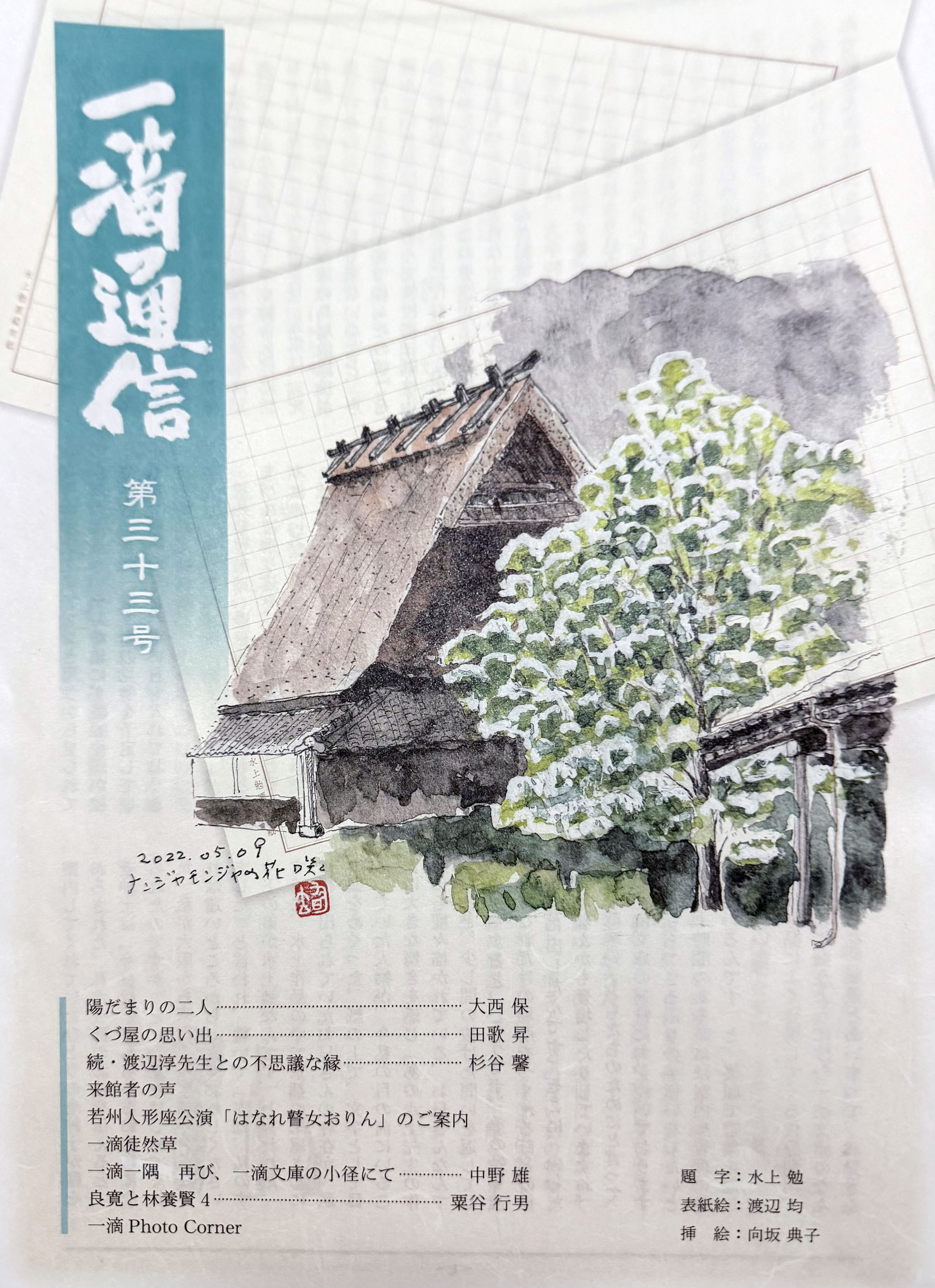
Two in the Sun
When I was an art university student, literary critic Takeo Okuno was at the university as a faculty member. He often proudly said, "The student appearing in Sei Ito's 'Hanran' (Flood) is modeled after me." One day, he called out to us, "Novelist Toshio Shimao, famous for 'The Sting of Death' (Shi no Toge), is here, so why don't you come too?" Having already read 'The Sting of Death,' I rushed into the professor's dormitory with joy and saw the literary figure standing in a kimono with downcast eyes. I remember holding my breath, thinking that this man was the author of that unconventional novel that could be described as rampant.
I feel that my pilgrimage through novels began from this one scene in my university days. I entered the worlds of novels depicted by many writers and thought about each world. And, of course, among them was Tsutomu Minakami, a writer who moved that turbulent era of Showa.
After some years had passed since then, I got a job as an art teacher at a certain school.
Since I was young, I have been stuffing Minakami's novels into my bag and turning the pages whenever I have free time, so I must have been seen as quite a fan of Minakami literature by those around me. To such me, a fellow teacher called out, saying that they were planning a field trip to visit the Jakushu Itteki Bunko library and would include me as a chaperone member.
On the day of the field trip, under a clear blue sky, I boarded a sightseeing bus and headed to Wakasa, suppressing my bouncing feelings of anticipation with many students. After some time passed since departure, a group of Japanese-style buildings appeared in front of me. The newly founded Itteki Bunko was full of vitality and hope, just as I had expected. The moment I felt that appearance and atmosphere, a feeling of gratitude welled up in my heart, "My friend did well to invite me."
Immediately, the students and we chaperones were guided into the park and were able to observe the main building, the bamboo doll hall, and the bamboo paper making process. Seeing the participating students' eyes shining happily and their hearts dancing at various exhibits, we teachers were all satisfied, feeling the success of this initiative to visit Itteki Bunko. While having lunch in the park and the children enjoying badminton and ball games in a corner of the garden, I sat down on a long bench and enjoyed a moment in the sun. Then, an elderly gentleman who had been guiding us through the hall earlier sat down on the empty side of the bench. When I expressed my gratitude for today, the gentleman started a conversation, asking, "Where did you come from today?" When I told him I came from Osaka, he said, "You came well from such a far place," and continued, "Actually, my immediate younger brother is Tsutomu Minakami."
Immediately, the existence of the older brother who had gone to Kyoto to train as a barber in Minakami's works went through my mind. I felt a great surprise that the person I had seen as characters on paper was now in front of me, and I returned a somewhat foolish question, "Are you that older brother who is often depicted in Mr. Minakami's works?" Then, he replied with a smile, "That's right. My brother Tsutomu also struggled and put out works that allowed him to create a place like this. I also appear a little bit there.
My brother is pouring his efforts into the operation of this Itteki Bunko for the children of his hometown, so I also want to help as much as possible, and when I have time, I am involved in guidance and management."
Combined with the Saburi River that often appears in Minakami's works and the indescribable scenery of Itteki Bunko standing along its flow, the older brother's words resonated very pleasantly inside me.
When I uttered the words, "Come to think of it, Mr. Sunao Watanabe, who is indispensable to Minakami literature, is also here, isn't he? I often see his pictures in illustrations and book designs, and he also appears in the works themselves. I believe he was the person who painted while delivering mail...", a regrettable response came back, "He was here just a moment ago."
He continued, "The fact that Sunao's name comes up means you like pictures. By the way, teacher, what subject do you teach?" He directed the conversation. I conveyed that I was in charge of art and uttered with momentum that I was still continuing my creative activities, mainly copperplate engraving. Then, he said, "What kind of works are they? I would definitely like to see them once."
I told him that I run around Japan choosing subjects for my paintings, but I am particularly fascinated by the scenery with Ika-style private houses in Yogo because of the wonderful description in Minakami's work "The Koto of the Lake" (Mizuumi no Koto), and I often visit that land to search for scenery that reflects the world of the novel and paint it.
Then he said, "Talking with you today, Mr. Onishi, was very interesting and intriguing. After all, I would definitely like to see your works once, and I would like to tell this story to my brother Tsutomu. I think Tsutomu would also say he wants to see your paintings."
The fun time passed in the blink of an eye, and it was time to return home with the students. I think I was caught in the sensation that my heart remained left behind at Itteki Bunko.
After a while, relying on the words of the older brother at that time, I visited Itteki Bunko again bringing my own copperplate prints, and was able to hand over the works I had longed to give. With the feeling that I could now take back my heart that I had left at Itteki Bunko, I was able to return home with great satisfaction this time.
How many days have passed since then? One day, when I had completely forgotten about entrusting my paintings to Itteki Bunko due to the busyness of daily life, a letter arrived at my hand. When I turned the envelope over, there were the characters of Jakushu Itteki Bunko and Tsutomu Minakami. My memory immediately recalled the situation of that day, and the words "I think Tsutomu would also say he wants to see your paintings" ran through my head, and I felt my heart beating fast to check the contents. And there it was,
"I would definitely like to add your work to the collection of Itteki Bunko."
My body became hot, and I couldn't speak well.
Receiving many connections, and feeling a strange sensation as if Mr. Tsutomu Minakami had seen my past hardships along with my paintings, I was speechless.
I think this story has become my story that will never disappear as long as Itteki Bunko connects to future generations. While being grateful for many encounters and this connection, I would like to put down my pen here.